
Strength Through Diversity
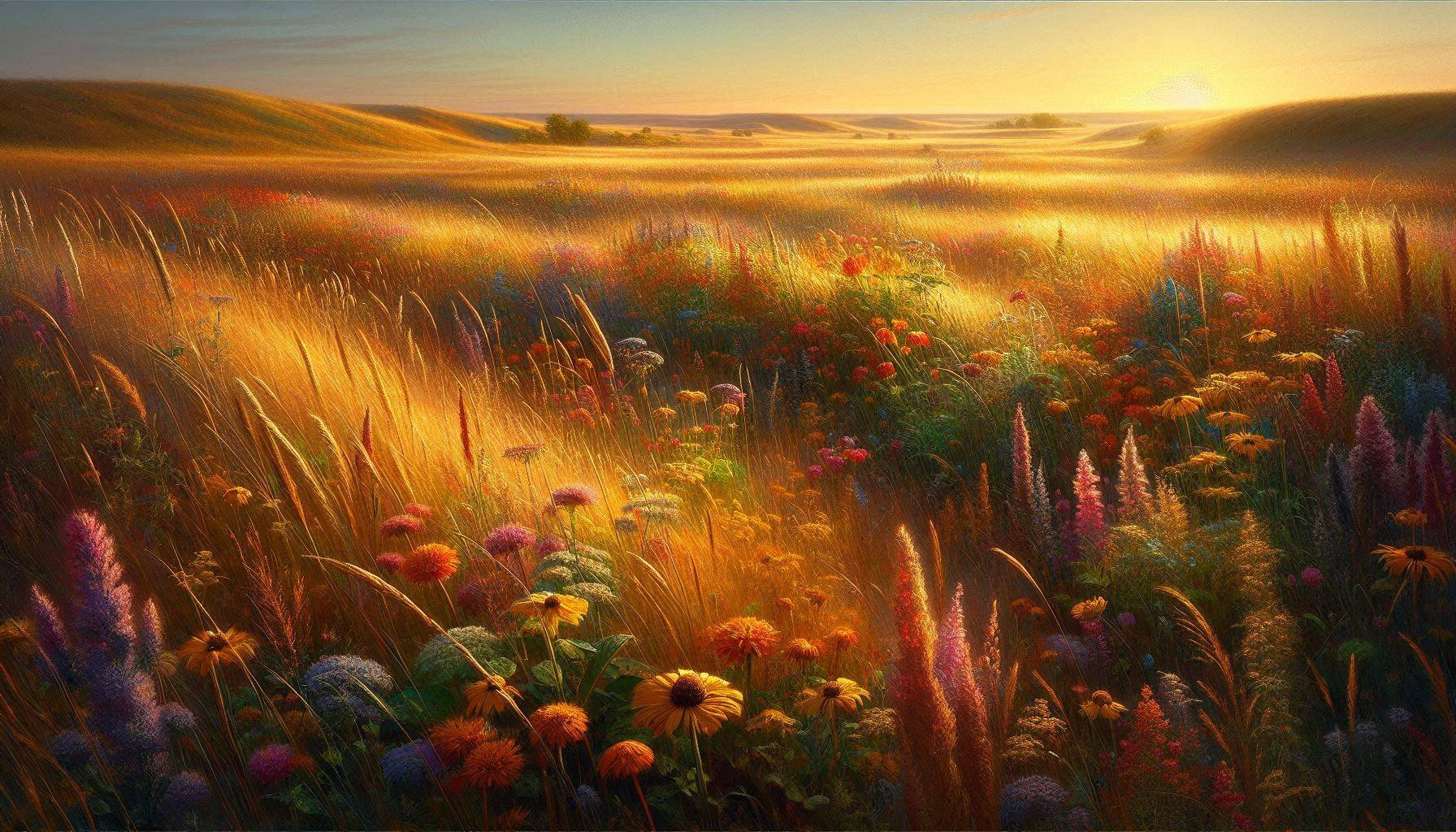
A prairie is not a lawn. A lawn is one kind of grass, cut flat. A prairie is dozens of plants growing through each other, and no two of them do the same job. Some grasses come up early in spring. Others wait for the July heat. Clover pulls nitrogen out of the air and works it into the soil. Deep-rooted flowers draw water from far below where the grass can reach. Together they take in more sunlight, more water, and more nitrogen than any one of them could on its own. A field like that is hard to kill.
Ecologists planted some plots with a single species and others with many, and watched them for years. The mixed plots grew more, and the gap widened as the roots divided the water and soil among them.[1] They also held steadier through both dry and wet years, while the single-species plots thrived in the good years and failed in the bad.[2] A field of one crop has one response to a hard year. A field of many has dozens, so when a shock hits, some plants fail while others hold the line.
In the 1840s, most of Ireland's poor lived on a single kind of potato, the lumper, replanted each year from the tubers of the last crop, so every plant was a copy of the one before it. When potato blight arrived, it swept through all of them at once and took the entire crop in a season. About a million people died in the famine that followed.[3]
The banana shows we still don't learn. The kind your grandparents ate, the Gros Michel, was also a clone, and a soil fungus drove it off the market in the 1950s. Growers replaced it with another clone, the Cavendish, and planted it everywhere. A new strain of that same fungus now kills the Cavendish too, and it's spreading through plantations across Asia, Africa, and Latin America, poisoning the soil for decades.[4] We lost one banana to a monoculture and answered by planting another.
Human systems are no different. A bank, an army, a government built on one idea has the same weak point as a one-crop field, and it comes apart the moment the world hands it a problem the single design can't solve. Variety is how a system survives what it didn't see coming. Narrow it down to one shape, and you've wagered everything on that shape never being wrong.
People who share a background tend to share blind spots. When everyone in the room has the same one, no one is left to catch it. Psychologists call it groupthink, the way a room of like minds talks itself into a bad decision without noticing. When researchers gave the same case to all-white juries and to racially mixed ones, the mixed juries deliberated longer, weighed more evidence, and made fewer mistakes of fact.[5] The people at that table had lived different lives, so they noticed different things, and together they caught what any of them alone would have missed.
Agreement can be more dangerous than conflict. Independent investigators traced the same failure behind both the Challenger and Columbia disasters. Each time, the specialists who saw the danger were overruled by a confident management that had stopped listening, and fourteen people died across the two flights.[6]
It shows up in how places make their living, too. A town built on one industry does fine until that industry leaves, and then nothing catches the fall. Regions with many kinds of work lose fewer jobs in a downturn and climb back faster than the ones that leaned on a single trade.[7] Even the 2008 crash ran on hidden sameness. Banks that looked independent had made the same bets and measured them with the same models, so a system that appeared diverse was really one enormous position, and when it broke, it broke everywhere at once.[8]
The people who preach purity as strength have it backwards. Every regime that set out to purify itself came out weaker for it. When Nazi Germany expelled its Jewish scientists, it lost about a sixth of its physicists, chemists, and mathematicians, many of the best among them. German science lost more to that purge than it would later lose to Allied bombing, and the hole still showed fifty years on.[9]
The Soviet Union went after ideas instead of people. Stalin's government backed one politically favored biology, condemned genetics as a bourgeois lie, and jailed the scientists who defended it. Nikolai Vavilov, who had built the largest seed bank on earth, a living library of crop diversity, starved to death in a Soviet prison.[10] The target was different and the damage was identical. Strip a country of its variety and it loses the ability to adapt when it has to.
The countries that stay open show the reverse. In the United States, immigrants are one in six of its inventors and produce close to a quarter of its patents.[11] A nation that takes people in draws on all of human talent instead of a narrow slice of it. When someone says a country has to stay uniform to protect its culture, look hard at what they're protecting. Fewer minds, fewer answers, a single point of failure, a monoculture dressed up as heritage.
The prairie outlasts the drought because it's built from many kinds of life, all working different jobs. A society works this way too, just larger. It runs on farmers and engineers, teachers and nurses, builders and inventors, each handling what the others can't, and it holds together under strain that would flatten a country of one kind of person.
An open society still has to defend its openness, holding the door against the people who'd shut it for good, which is a problem of its own. But the payoff is worth the trouble. A system made for many kinds of people, and many ways of taking part, takes far more work to build than a monoculture, and some of us are building one anyway. Anyone can plant a single crop. It's cheap, it grows fast, and it looks like the sensible bet, right up until it dies all at once the first time something arrives it never planned for. A field of a hundred different roots is harder to grow, and it's the one still standing when the dry year comes.