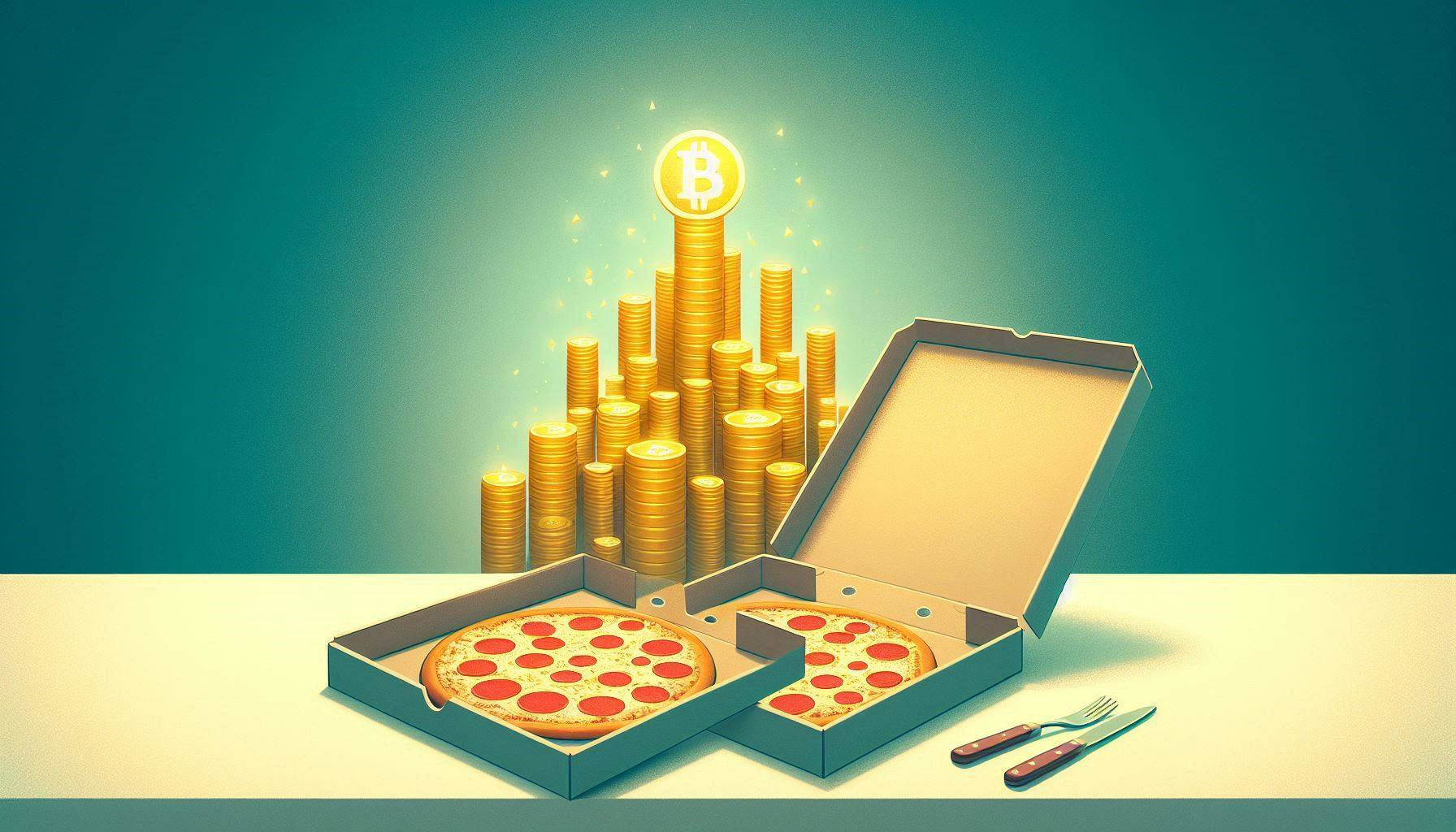

The World's Most Expensive Pizza
On May 22, 2010, a programmer in Jacksonville named Laszlo Hanyecz paid for two large pizzas with 10,000 bitcoins. That came to about forty dollars at the time. Today it would be a billion-dollar dinner.[1]
The internet has never let him live it down. Every May 22 it dusts off the same joke, the man who ate a fortune, and marks the anniversary as an unofficial holiday: Bitcoin Pizza Day. The joke has the story backwards, and Hanyecz understood something the people telling it still miss.
Go back to 2010. Bitcoin was about sixteen months old. It had been built to route around the banks that cratered the economy in 2008, its entire purpose stamped into the first block it ever produced. What it had never done was buy anything. A currency only becomes a currency when someone spends it, and nobody had.
Hanyecz decided to be the one who did. He was no amateur. He'd been mining bitcoin since the earliest days and had thousands of coins to his name.[2] He knew exactly what he was holding. He simply thought a currency ought to buy something. So he posted an offer to the Bitcoin forum:
"I'll pay 10,000 bitcoins for a couple of pizzas.. like maybe 2 large ones so I have some left over for the next day."[3]
He listed his toppings, offered to take delivery or homemade, and waited. Four days later a nineteen-year-old named Jeremy Sturdivant took him up on it, placed the order, and pocketed the coins. That evening Hanyecz posted a two-line victory lap: he had "successfully traded 10,000 bitcoins for pizza."
It was the first time bitcoin had ever bought something real. There is a plaque on that Jacksonville pizzeria today naming the city the home of the first Bitcoin purchase.[4] That moment, more than any line of code, is when a curiosity became a currency.
Now, about that billion-dollar dinner. The figure imagines those exact coins sitting untouched in a wallet for fifteen years, quietly swelling into a fortune. Sturdivant spent them within months, back when they were worth a few hundred dollars, and from there they scattered across the network into more hands than anyone could trace.[5] So the billion is a fiction. Those coins never sat still long enough to make anyone rich.
What the mockery misses is simpler and stranger. Bitcoin is only worth something today because people were willing to spend it and take it in return, over and over, starting when it could buy a pizza and little else. Every holder sitting on coins right now, feeling clever, is standing on a floor the spenders laid. Take away the people who "wasted" their bitcoin in those early years and there is no price left to feel clever about.
Money has always run on this. A dollar is worth something because the next person will take it, and they take it because they trust the person after them to do the same. Acceptance is the entire asset. As the Federal Reserve Bank of Richmond stated in a 2024 paper on why money exists at all:
"It eliminates the need for barter and facilitates economic activity by making transactions more efficient."[6]
Circulation is the job. A token everyone buys and nobody spends is a Beanie Baby with a better story, worth exactly what the next buyer will pay and not a dollar past it. Hanyecz's two pizzas were the first evidence this experiment could do the one thing money has to do: buy real goods from the people selling them.
The same is true for anyone early in a new currency today. It is tempting to treat a fresh token the way people wish they had treated bitcoin, as a lottery ticket to buy and bury. But a coin that only gets hoarded never turns into money. It stays a bet, and most bets don't pay. MUNNY is no exception. I have made the case for what it is and why it exists elsewhere. What will give it value is exactly what gave bitcoin value: people using it. Whoever accepts it first for real work, spends it first on something they needed anyway, and proves the loop closes is doing the work that makes the whole thing worth anything. If you want a token economy to be worth something someday, spend it today. Buy the pizza.
As for Hanyecz, he is doing just fine. He was never the sucker in this story. He came out of those early years with plenty, kept building, and by every account is more than comfortable. In 2018 he bought pizza with bitcoin all over again, this time over the Lightning Network, purely to prove you still could.[7] Ask him whether he regrets the most expensive meal in history and he will tell you he doesn't:
"A trade happens because both parties think they're getting a good deal. I felt like I was beating the internet, getting free food."[8]
He was right. Somebody had to spend the first coin to prove the stuff was money, and he did it for two large pizzas with the works. The rest of us have been eating off that trade ever since.