The Future Is Calling
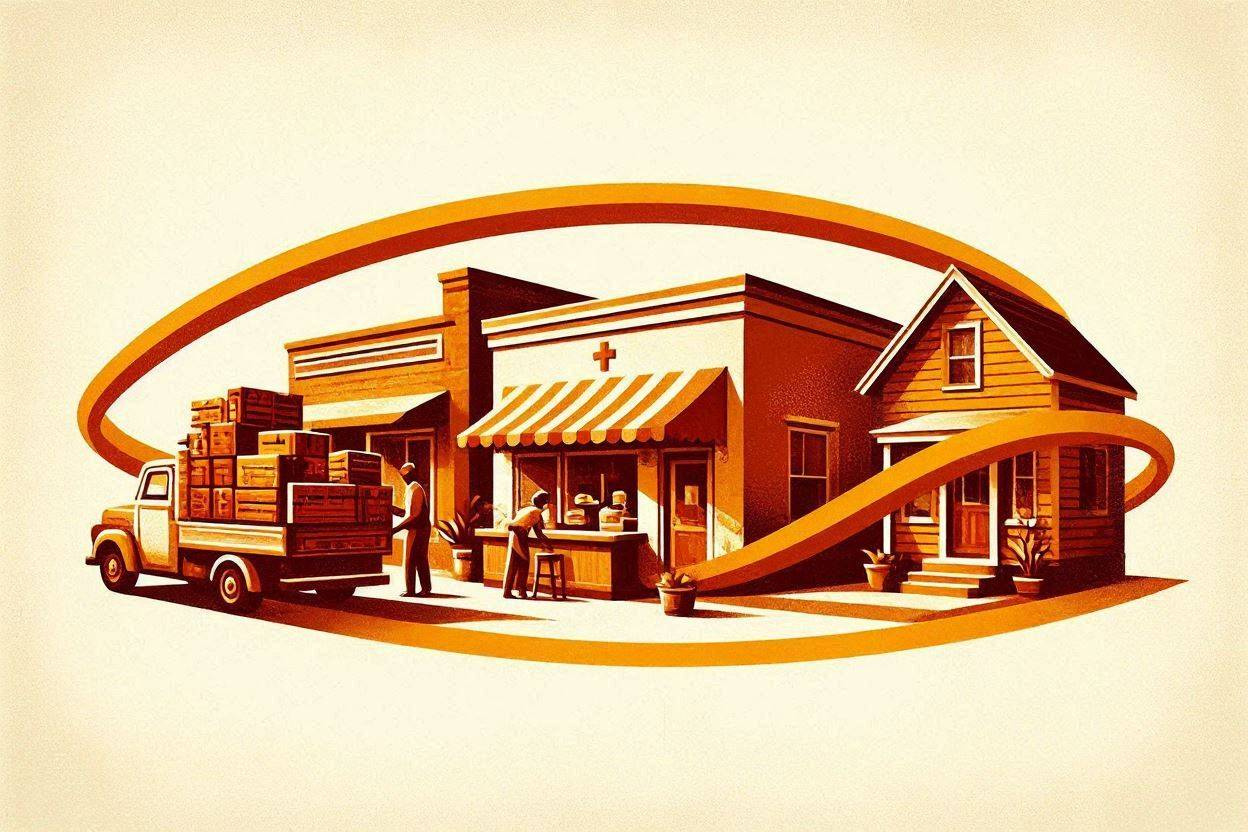
Ana's tomatoes go onto the co-op truck at six, bound for a market four hours off. The drivers own shares in that truck. The freight money stays in town, and the sale itself brings in currency from outside. Every town needs some of that coming in.
Dale comes by in the afternoon to replace the pipe under her sink, and she pays him in MUNNY before he's back in his van. He eats at Nadia's counter most days and pays there in MUNNY too. Nadia buys the tomatoes Ana didn't ship.
The money left Ana's hands and was back in them inside a week, and everyone it passed kept what they earned along the way. Nothing was skimmed by anyone who never handled a crate, a wrench, or a plate.
Every member gets MUNNY daily, the same amount for everyone, for no reason except belonging. It doesn't make anyone rich, but it means no one has to take the first job that comes along.
Nadia's daughter had an ear infection in February. The clinic on the square is owned by the people who work in it, the doctor and the nurses and the woman at the front desk, and it takes MUNNY like everywhere else. What Nadia paid went into their hands, and most of it will have come back through her counter by spring.
A family closed on a house last spring. They own the building. The ground underneath belongs to the community and always will, so the price they paid was a price a family can pay, and it stays that way for whoever comes next.
A slice of every trade in town goes into a common fund, and the members vote on where it goes. It put more trucks on the road last year, because Ana isn't the only grower waiting on a run to the city. The year before that it paid to sink a well on the north side.
That's the world we're building. Every piece of it already runs somewhere on earth, and most of it has for decades.
A hundred years ago the power companies ran their lines out to the edge of the cities and stopped. Past that the customers were too far apart to be worth the wire, and where service reached at all it cost farmers double what townspeople paid, with the farmers expected to put up the poles themselves.[1] So they built it. Neighbors pooled what they had, borrowed against a federal program set up for exactly this, and strung the line across their own fields. Their grandchildren own it still, and the grid runs to 42 million people today.[2]
A priest in a Basque valley opened a technical school in 1943, twenty-one students the first year. Five of its graduates started a workshop in the fifties. Those cooperatives are still running, still owned by the members who work in them. A member buys in today with a stake of around €17,000, paid down slowly over years, and the stake carries a vote in the assembly that decides where the whole thing goes.[3] Whoever runs the place can't take home more than six times what the newest hire on the floor does. The federation turns over more than €11 billion a year now, and it has grown a bank and a university of its own out of what it earned.[4]
Swiss business owners built their own money in the middle of the Depression, when the banks had stopped lending and there wasn't enough national currency to go around. It still circulates today, and economists who studied it found that people spend more of it in hard years, when ordinary cash is scarce.[5]
And in a Vermont town, a house went onto common ground in 1991. It cost $109,000, and the trust holding the land put in $22,000 to bring it inside what the family could carry. When it sold again in 2019 at $275,000, the trust put in $115,000, and the second family walked in on the same terms the first one got.[6]
All four are real places with real people in them, and every one has been running for a generation or more, kept going by farmers and machinists and shopkeepers who wanted what they depended on to belong to them.
So why isn't this everywhere? Some of it is simple enough. Every one of them sends money to the people who earned it, straight past people accustomed to taking a cut, and that fight is as old as the systems themselves.
The bigger reason is that all of them had to build everything themselves, alone, from nothing. A ledger, a membership roll, lawyers, thirty years of earned trust, all from scratch. The Swiss couldn't lend their currency to the Basques. The Vermonters couldn't hand their land model to a town in Kenya. Each one was an island, and building an island takes a lifetime. An island can also be sold. A board changes its mind, a founder dies, the heirs take the offer, and thirty years of somebody's work belongs to a stranger.
That's the gap BRIJ closes. One foundation, shared, where a community anywhere can put up a housing trust, a co-op, a budget and a safety net without spending thirty years inventing the machinery first, and where all of it settles in the same money. The organizing still has to happen. What goes away is the decade spent building the tools to organize with. And the rules that matter are written in code rather than in policy, so who owns what, how the money is issued, and how a decision gets made stay where the community put them, and nobody who ends up running the place later can quietly move them.
Money carries the priorities of whoever designed it, and every currency in common use was designed by someone with other priorities. MUNNY is built to keep moving, and its worth comes from what it can buy, so every shop and every trade that joins makes it better money for everyone already holding it. Nobody can print more of it to cover a debt somebody else ran up.
A bigger pile of chips wins by making the other side too broke to hold out, which is why every one of these removes the other side from the table. A town that owns its wire has no utility to negotiate with. Workers who own the company set the wage among themselves. Ground held in common has no landlord to raise the rent. And a floor underneath makes saying no affordable.
Most of what Ana's town runs on was started by people who are gone now. The farmers who strung that wire got their own lights out of it, and their grandchildren got a grid. The priest who opened the school with twenty-one students didn't live to see the university. That's how anything worth having gets made, by people willing to plant trees they'll never sit under.
The difference now is that some of the trees are already grown. Somebody still has to call the meeting, open the shop, put the first house on common ground, and get the neighbors to come in.
The future has been calling a long time. It's asking for volunteers.