Intersectionality & Unity
Before 1970, General Motors' plant in St. Louis had employed one Black woman. That year the company began hiring Black women onto its production lines. When the next round of layoffs came, it ran by seniority, and every Black woman on the production floor lost her job.[1] Five of them sued. In 1976 the court ruled they could bring a case for race discrimination or for sex discrimination, but not for the two combined. The sex claim failed on its own, because GM had been hiring women for decades, even though nearly all of those women were white. The court set the race claim aside and tried to fold it into a separate race case already pending against GM, so nowhere in the process was there a box for them as Black women.
In 1989 the legal scholar Kimberlé Crenshaw built a paper around that case and gave the problem a name, intersectionality. A Black woman can be harmed by racism, by sexism, or by both at once, and a rule that only looks for one of them at a time misses the case where both did the damage. She explained it with traffic:
"Consider an analogy to traffic in an intersection, coming and going in all four directions. Discrimination, like traffic through an intersection, may flow in one direction, and it may flow in another. If an accident happens in an intersection, it can be caused by cars traveling from any number of directions and, sometimes, from all of them. Similarly, if a Black woman is harmed because she is in the intersection, her injury could result from sex discrimination or race discrimination."[2]
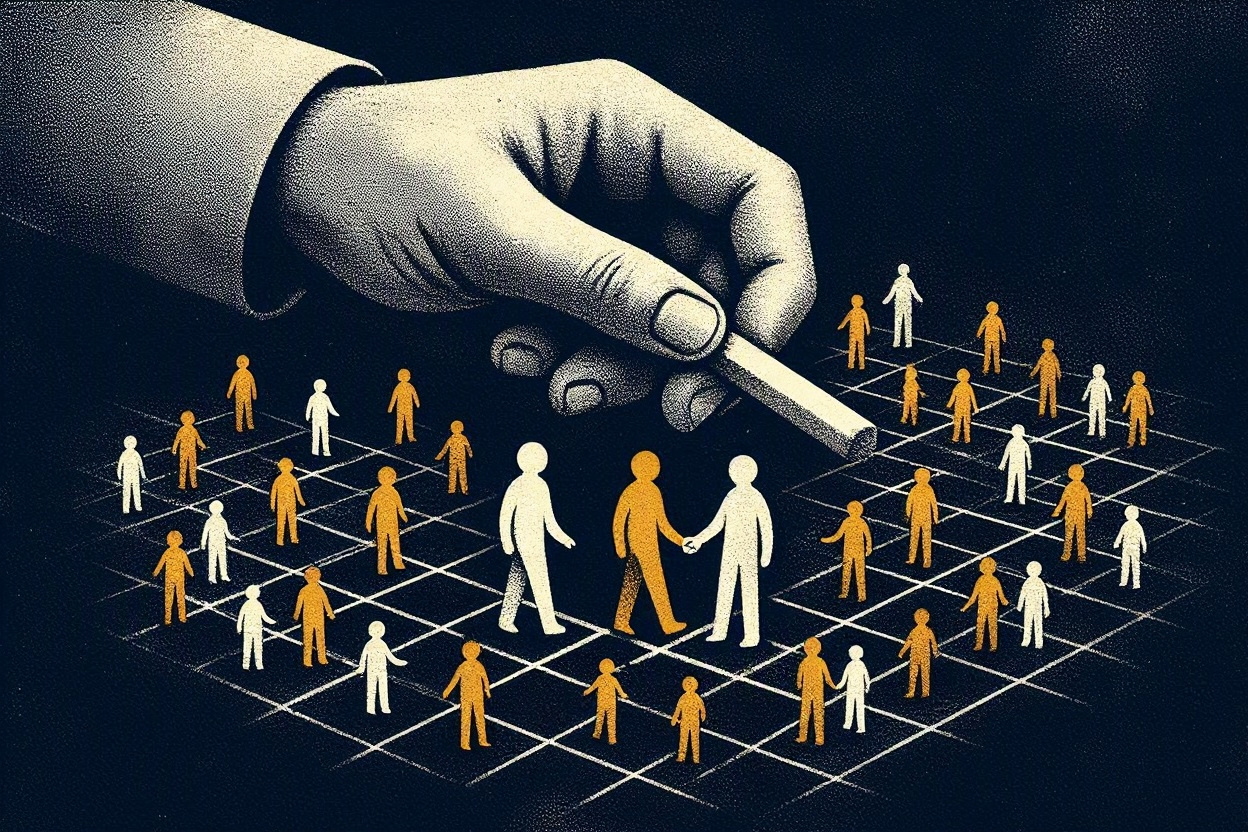
Those women belonged to two groups at once, and so does nearly everyone. A miner can be gay, an immigrant can be disabled, and a veteran can be a renter. Each of those people carries one group's problems into another group's meetings, so groups overlap through their members whether anyone plans it or not. Those groups are pushed around by the same system, whether it shows up as a company, a city hall, or a federal agency. That gives any two of them more in common with each other than with the system pushing them. Every year they spend fighting each other is a year the people who profit from that system keep what they have without having to defend it. Two habits keep that fight going. One is keeping score, ranking whose suffering counts most. The other is zero-sum thinking, the belief that whatever one group gains has to come out of another group's share.
In 1866, a year after the Civil War ended, campaigners for women's suffrage and for Black suffrage formed one organization, the American Equal Rights Association. Then came the proposed 15th Amendment, which barred denying the vote on account of race and said nothing about sex. Frederick Douglass and Lucy Stone backed it as the win that could be had now, with women's suffrage to follow. Elizabeth Cady Stanton and Susan B. Anthony wouldn't accept a win that left women out. The fight over whose vote should come first broke the alliance apart in May 1869. Out of the break, the women's movement formed two new rival suffrage organizations of its own,[3] and the two didn't join forces until 1890.[4] The split is part of why women's suffrage was delayed into the twentieth century. Taking the first win together and pushing on for the second is what keeps an alliance intact.
At a 1993 forum in San Diego on building coalitions among people of color, the activist Elizabeth Martínez called keeping score the "Oppression Olympics," said that "no competition of hierarchies should prevail," and warned that "the whole idea of making a hierarchy of demands is sure death from the beginning."[5]
When Black residents of Montgomery, Alabama, sued to desegregate the city's parks, the city shut every park, playground, athletic field, and swimming pool "to all persons, white and black," effective January 1, 1959. That's zero-sum thinking. The parks stayed officially closed until 1965. The pools never reopened.[6] The city took the pools away from its white residents too, rather than let Black residents swim in them. Across six studies, researchers found that people see life as zero-sum "when it benefits them to do so," switching the belief on for whatever issue suits them and off for the rest.[7]
In 1968 the FBI opened a campaign against Black political organizations, and the first goal on its list was preventing coalition. The same split decides elections without anyone having to arrange it, because under the usual way of counting votes a divided majority loses to a united minority. Martínez told the same forum that if an administration "will pick your groups off one by one, then the largest umbrella you can possibly get is probably the best one." A movement made of one kind of person can be beaten with one tactic, and a movement made of many kinds of people has to be beaten several different ways at once.
Strangers from different groups become allies when they work toward the same win. Researchers in India randomly assigned young men from different castes to cricket leagues. Some landed on mixed-caste teams and some didn't, and their opponents were assigned at random too. The men who played alongside other castes made more friends across caste lines and favored their own caste less afterward. The men who met other castes only across the pitch, as opponents, mostly kept their distance later.[8] Same game, same kinds of strangers, and the one thing that decided whether they ended up friends was which side they played for. The men on the mixed teams never had to agree on anything beyond winning the match, and putting different groups on one side like that is the whole job of a coalition. Martínez told the forum:
"...coalitions, networks, and alliances should never make the mistake of demanding ideological unity. They can expect unity around an issue."
In March 1984 Britain's miners went out on strike. A month later, customs officers raided a gay bookshop in London and seized about 800 books.[9] A group of gay and lesbian activists in London saw the same state at work in both, and one of their organizers later described "media distortion, police harassment and state oppression of both the mining communities and lesbians and gays."[10] They started raising money for striking miners and their families in South Wales, and in October 1984 they visited the miners' welfare hall in Onllwyn, a pit village. By the time the strike ended in March 1985, more than sixty people had joined the London group and they had raised about £20,000. The miners lost.[11]
A few months later, a group of miners marched at the head of London's Pride parade into Hyde Park alongside the activists who had backed them.[12] Later that year, at the Labour Party conference, the National Union of Mineworkers put its block vote behind a motion for lesbian and gay rights, and the motion carried. On paper, a Welsh pit village and a room full of London activists had nothing in common. They had the same opponent, and that was enough to make each group's fight the other's, well after the strike that brought them together had ended.